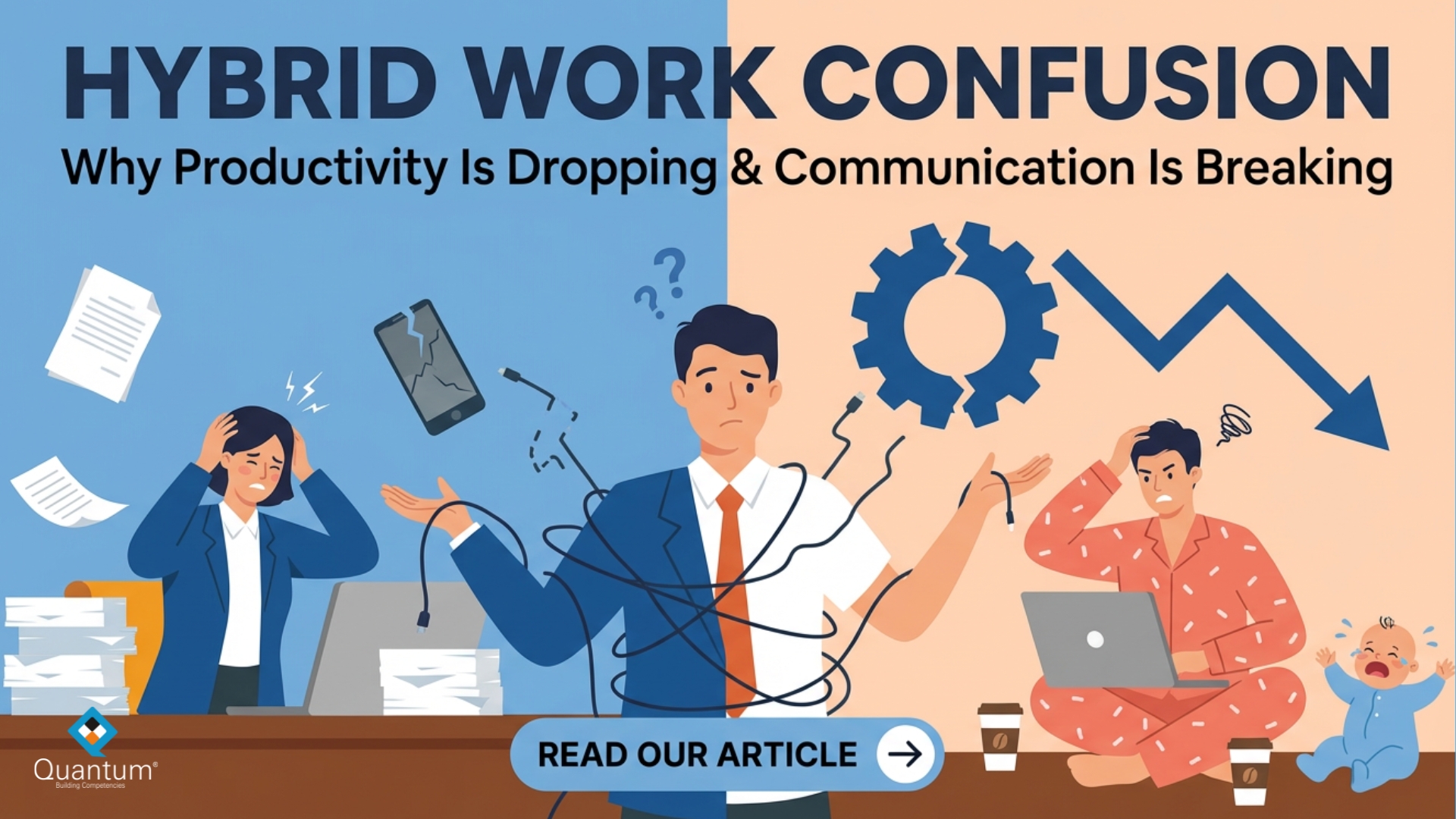
Opening scene — the meeting that explains everything
The meeting was scheduled for 10 am.
Three people joined from the office.
Two joined from home.
One joined late because of traffic.
Another kept saying, “Sorry, can you repeat that? My audio dropped.”
Halfway through, the office group started a side discussion.
The remote participants went silent.
Decisions were assumed.
Responsibilities were unclear.
After the meeting, everyone felt busy.
But no one felt aligned.
This scene is playing out daily across organisations that adopted hybrid work without redesigning how work actually happens.
Hybrid work was meant to give flexibility, balance, and better productivity.
Instead, many companies are seeing slower execution, more confusion, and weaker communication.
The problem is not hybrid work itself.
The problem is hybrid work without structure.
The illusion of flexibility
Hybrid work promised the best of both worlds.
Work from home when needed
Office collaboration when required
Freedom with accountability
But what many organisations implemented was:
Unclear attendance rules
Inconsistent availability
Uneven access to information
Different expectations for office and remote employees
Flexibility without clarity quickly becomes chaos.
Where productivity is really getting lost
1. No shared rhythm of work
In fully remote or fully in office setups, teams eventually find a rhythm.
Hybrid breaks that rhythm.
Some start early.
Some start late.
Some are available on chat.
Some respond hours later.
Without agreed working windows, collaboration slows down and tasks stretch unnecessarily.
2. Meetings no longer work for anyone
Hybrid meetings are exhausting.
Remote employees feel invisible.
Office employees dominate conversations unintentionally.
Discussions happen before and after meetings in corridors.
Decisions get made in fragments.
What suffers most is clarity.
3. Communication moves to assumptions
In hybrid setups, people assume others know things.
Someone in office says, “We discussed this yesterday.”
Remote employees hear about it later.
Context gets lost.
This leads to repeated explanations, duplicated work, and growing frustration.
4. Accountability becomes blurred
When teams are not physically together, ownership must be explicit.
But in many hybrid environments:
Tasks are discussed but not documented
Deadlines are mentioned but not tracked
Follow ups are assumed
People feel they are working hard, yet outcomes remain unclear.
5. Emotional disconnect increases quietly
Hybrid work reduces informal interactions.
No casual desk conversations
No quick clarifications
No emotional check ins
Over time, people feel disconnected, misunderstood, or excluded.
And when emotional connection drops, communication quality drops with it.
Why managers are struggling the most
Managers are caught in the middle.
They must:
Manage visibility without micromanaging
Trust output without seeing effort
Support remote employees emotionally
Coordinate office-based collaboration
Handle complaints from both sides
Most managers were never trained for this.
So, they rely on control or over communication, both of which increase stress.
The real issue: hybrid work exposed weak systems
Hybrid work did not create these problems.
It exposed existing ones.
Lack of clarity
Poor meeting discipline
Weak communication norms
Undefined roles
Low emotional intelligence
When people are together physically, these gaps are hidden.
In hybrid setups, they become obvious.
How organisations can fix hybrid work confusion
Hybrid work needs intentional design, not trial and error.
Here is what actually works.
1. Define clear hybrid work principles
Teams must know:
Who comes to office and when
Why those days matter
What decisions require physical presence
What work can be done remotely
Clarity reduces resentment and confusion.
2. Redesign meetings for hybrid reality
Hybrid meetings should follow simple rules:
Everyone joins from their own device
Remote participants are acknowledged first
Decisions are documented live
Actions are assigned clearly
Meetings should not favour location.
They should favour clarity.
3. Move information from memory to systems
In hybrid work, if it is not written, it does not exist.
Use shared tools for:
Decisions
Updates
Project status
Next steps
This removes dependence on who was present.
4. Train teams on clear communication
Hybrid communication needs discipline.
Short clear messages
Explicit deadlines
Documented expectations
No assumptions
Clarity becomes the new productivity multiplier.
5. Build emotional connection deliberately
Hybrid teams need structured human connection.
Regular check ins
Camera on moments when possible
Non work conversations
Recognition rituals
People work better when they feel seen, not just monitored.
A transformation story from the field
A consulting firm struggled with hybrid chaos.
Remote employees felt excluded.
Office employees felt overburdened.
Managers were frustrated.
They introduced:
Clear hybrid guidelines
Structured meetings
Documented workflows
Manager training on hybrid leadership
Emotional intelligence sessions for teams
Within two months:
Decision cycles shortened
Miscommunication reduced
Team trust improved
Productivity stabilised
Hybrid work stopped being a problem.
It became a system.
A 30 60 90 day roadmap to fix hybrid productivity
Days 1 to 30: Diagnose and stabilise
• Identify hybrid pain points
• Define availability windows
• Redesign meeting rules
• Document workflows
Days 31 to 60: Train and align
• Train managers on hybrid leadership
• Improve communication standards
• Introduce emotional check ins
• Set accountability systems
Days 61 to 90: Embed and scale
• Review hybrid effectiveness
• Adjust office days purposefully
• Recognise collaboration behaviours
• Continuously refine systems
Manager scripts that reduce confusion instantly
• “Let us document this so everyone has clarity.”
• “Who owns this and by when.”
• “Remote voices first, then office.”
• “If it is not written, it is not decided.”
Simple language. Strong alignment.
Final thought
Hybrid work is not failing.
Unstructured hybrid work is.
Productivity drops when systems rely on proximity.
Communication breaks when clarity is optional.
Hybrid work succeeds only when organisations redesign how work, communication, and leadership function in a distributed environment.
Those who invest in this shift will build resilient, future ready teams.
At QICPL, we help organisations make hybrid work actually work.
Our hybrid productivity, communication, and emotional intelligence programs help teams regain clarity, alignment, and trust in flexible work environments.
If hybrid confusion is slowing your teams down, let us help you redesign it the right way.