Opening scene – the moment no one notices
8:45 AM, Mumbai.
Ankita walks into the office, coffee in hand, trying to look composed.
She spent half the night replaying a tense conversation with her manager.
Her colleague whispers, “Morning! Big day today?”
She smiles and says, “Yes, all good.”
But inside, her mind is already drowning.
By noon, she has checked the same email five times, started three tasks, and finished none.
By evening, she feels exhausted, guilty, and behind.
Her output drops but not because she lacks skill.
It is because she is carrying an emotional weight no one sees.
This story repeats thousands of times across Indian workplaces every day.
And yet, most companies still think the productivity problem is about skills, effort, or deadlines.
But the real problem is much quieter:
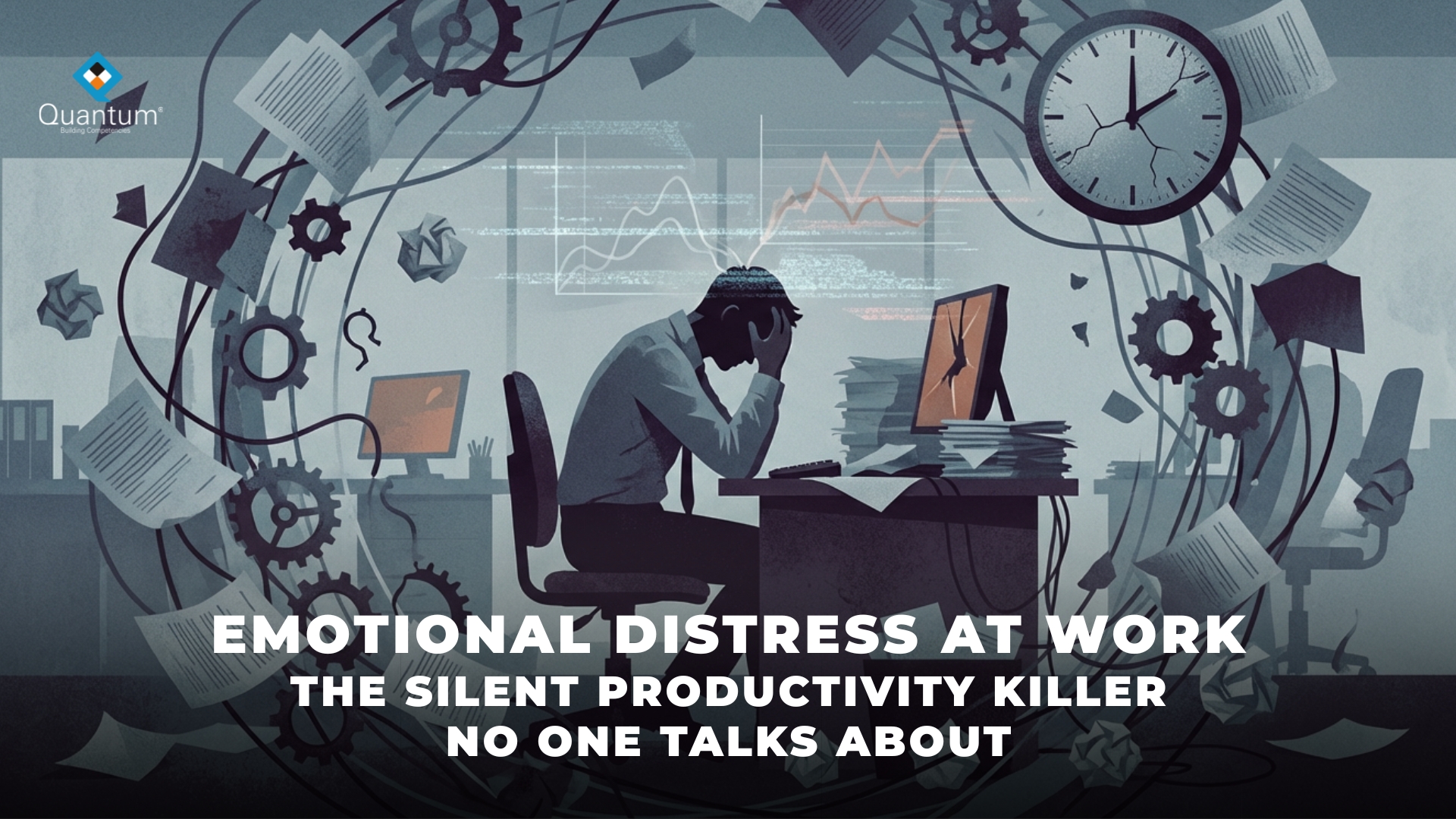
Emotional distress is silently draining focus, clarity, and performance — far more than people realise.
This article breaks down what emotional distress at work actually looks like, why it is increasing, and what teams can practically do this month to fix it.
What emotional distress really looks like (it is not always tears)
Most people imagine emotional distress as breakdowns or visible stress.
But in the workplace, it shows up in subtler ways like:
• Overthinking every small decision
• Avoiding conversations that matter
• Feeling stuck even when workload is manageable
• Constant self-doubt
• Procrastinating because the mind is overloaded
• Feeling numb or disconnected
• Taking things personally
• Becoming unusually irritable or withdrawn
• Struggling to start or finish tasks
These behaviours are often labelled as laziness or lack of ownership.
But the truth is simple:
When the mind is overloaded emotionally, productivity collapses.
Not because the person is incapable, but because their emotional bandwidth is already full.
Why emotional distress is rising especially in Indian corporate life
Several patterns make this problem uniquely severe in Indian workplaces:
1. No one wants to “look weak”
Employees hesitate to share emotional struggles.
Not because they don’t trust the company, but because they fear being judged as incompetent.
2. Overconnected culture
Teams stay connected through WhatsApp, Slack, and calls at all hours.
The brain never gets a full emotional reset.
3. High pressure to perform without fail
Even a small slip feels career threatening.
This creates silent internal pressure that builds up daily.
4. Limited emotional literacy
Most people were never taught how to recognise or manage emotions.
They only realise something is wrong when performance drops or burnout hits.
5. Managers lack training to handle emotional signals
Managers know how to ask about tasks.
But very few know how to notice emotional strain early.
The hidden cost: how emotional distress destroys productivity
Unmanaged emotional distress leads to:
• Lower focus
• More mistakes
• Decision fatigue
• Slower task completion
• Avoidance of difficult conversations
• Unclear communication
• Conflict escalation
• Last minute rushes
• Falling motivation
Think of productivity like a pipeline.
Every drop of emotional distress becomes a blockage.
Enough blockages, and the entire system slows down.
Many organisations think they have a skill problem or time problem.
But often, they have an emotional resilience problem.
A simple framework to diagnose emotional distress — the 4 signals
You can identify emotional distress early using these four signals:
1. Behavioural shift
Is someone quieter, distracted, reactive, or unusually tired?
2. Output inconsistency
Good days and bad days with no predictable rhythm.
3. Communication changes
Shorter messages, delayed responses, hesitations, irritability.
4. Energy drop
People complete tasks but look emotionally drained after.
These signs appear weeks before performance drops publicly.
Catching them early is the key.
Five practical fixes teams can implement this month
1) Create Emotional Check in Moments
Just 3 to 5 minutes at the start of a meeting to ask,
“How is everyone feeling today”
Not a therapy session
Not oversharing
Just awareness
This single habit increases empathy and psychological safety.
2) Train managers to listen without judgement
Most managers jump into solutions or say “it will be fine”.
But employees need:
• Space to speak
• Validation
• Simple next steps
Teach managers three behaviours:
- Listen fully
- Label what they heard
- Ask one helpful question
This changes everything.
3) Reduce emotional overload by reducing ambiguity
Unclear tasks create emotional stress ten times larger than workload stress.
Fix this by defining:
• What needs to be delivered
• By when
• What good quality looks like
• Who approves it
Clarity is an emotional muscle saver.
4) Build micro recovery routines
Encourage people to take:
• Two five-minute pause breaks daily
• Short walks
• Screen free moments
• Breathing resets
These reduce emotional heat and restore mental energy.
5) Offer structured emotional intelligence training
Skill training increases output.
But emotional intelligence training increases the number of days people can bring their best selves to work.
We have seen teams transform within weeks when they learn:
• How to recognise emotions
• How to pause before reacting
• How to handle triggers
• How to communicate clearly under stress
• How to maintain emotional boundaries
A real transformation story
A global IT services client came to us with rising conflicts, missed deadlines, and high attrition.
None of these were technical issues.
People were emotionally exhausted.
They implemented:
• Weekly emotional check ins
• A simple clarity framework for tasks
• Manager EI training
• Micro recovery breaks
In eight weeks:
• Conflict decreased
• Turnaround time improved
• Clients reported better communication
• Team morale visibly lifted
The best part
People said, “I feel lighter at work.”
A 30 60 90-day roadmap to reduce emotional distress at work
Days 1 to 30: Awareness and quick wins
• Introduce emotional check ins
• Train managers in listening skills
• Add clarity frameworks to tasks
• Encourage two pause breaks daily
Days 31 to 60: Culture shaping
• Build emotional literacy through short learning sessions
• Redesign meeting overload
• Document expectation clarity for teams
• Start weekly reflection practices
Days 61 to 90: Embed and sustain
• Introduce simple emotional resilience metrics
• Create a safe channel for early distress signals
• Celebrate emotionally healthy behaviours
• Train teams on conflict prevention
Manager scripts you can use tomorrow
• “No need to rush. Tell me what is bothering you.”
• “What do you need right now to feel supported”
• “Let us define clarity so you don’t have to carry mental load.”
• “Take five minutes. Reset. Then we continue.”
Small sentences. Big emotional relief.
Quick checklist to share with your team
• Are you taking emotional pauses
• Are tasks clear
• Are you talking about difficult emotions before they escalate
• Are managers listening
• Are you recognising early signals in each other
Final thought — emotional health is not a personal issue
It is a workplace performance issue.
Teams do not break because of workload.
They break because of emotional overload.
Fixing this does not require huge budgets.
It requires awareness, culture shifts, and training that helps people understand themselves and each other better.
And that is exactly why emotional intelligence training is becoming essential for modern workplaces. It helps teams stay clear, calm, and collaborative even during high pressure phases, the true foundation of consistent productivity.
#QuantumGroup #EmotionalDistressAtWork #CorporateIndia #PeopleFirstLeadership #LeadershipDevelopment