Walk into any modern office in India today and you will hear the same complaints.
“We are busy the whole day but nothing moves.”
“We start tasks but somehow never finish on time.”
“We have meetings back-to-back and no time to do actual work.”
It is not a lack of talent. It is not a lack of effort.
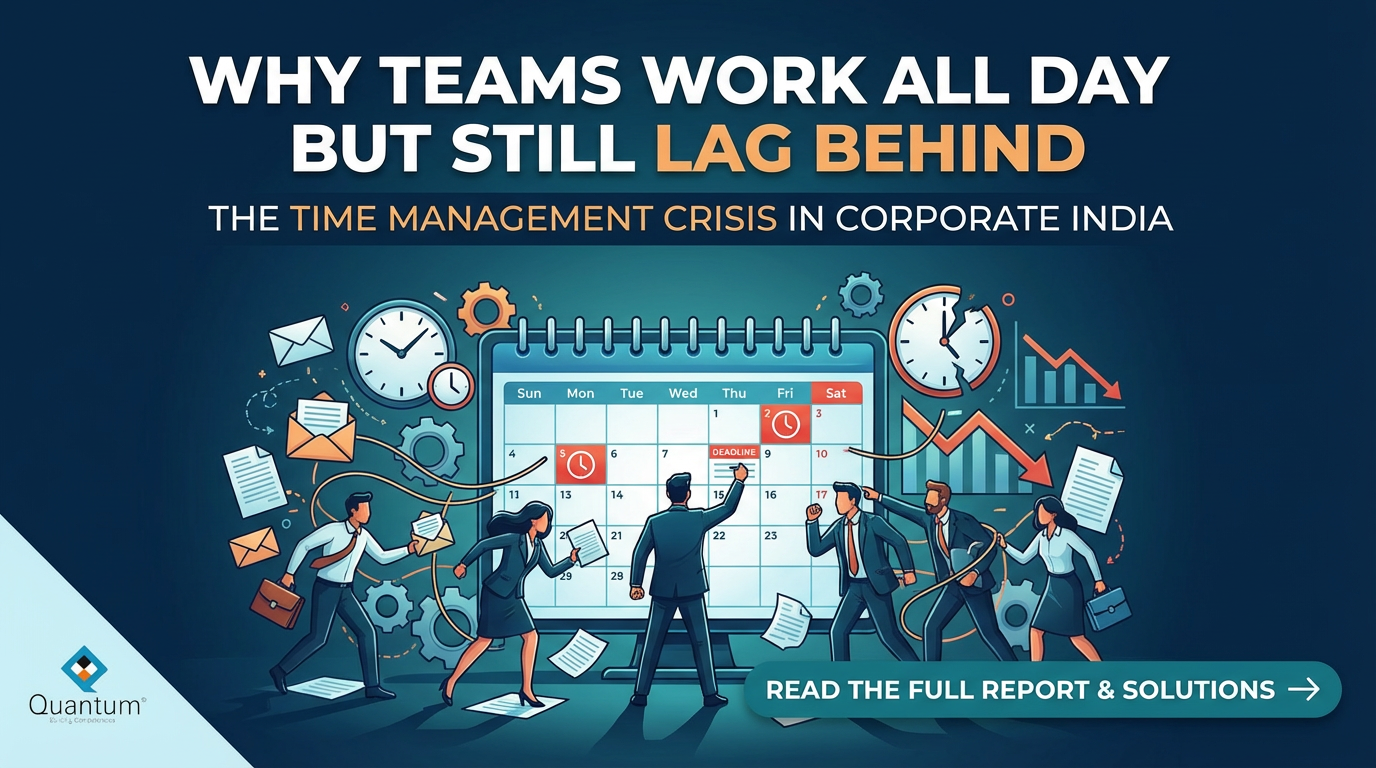
It is a time management crisis silently eating away productivity in corporate India.
At QICPL, we see this pattern repeat across industries, from tech to telecom to BFSI to manufacturing. Teams work hard but are constantly behind. Deadlines slip. Stress builds. Managers feel they are firefighting every single day.
The real question is: Why does this keep happening even in high performing teams
Let us break it down with what actually happens inside offices.
1. The Daily Workflow Chaos: Everyone is Doing Everything at Once
Most teams are juggling multiple tasks at the same time.
Emails keep coming.
Calls keep interrupting.
A colleague walks in with a “quick question”.
A senior messages “Can you check this now”
By the time they return to their original task, they have forgotten half of what they were doing. They restart. They lose flow. They lose time.
Multitasking feels productive but kills productivity.
When 10 tasks move forward by two percent each day, nothing gets completed and the team keeps feeling behind.
2. Meetings Without Outcomes
India loves meetings.
Daily standups that do not stand up.
Review meetings that review everything except decisions.
Status meetings with no status.
Brainstorming sessions with no action.
Meetings are important.
But meetings without clarity only drain energy and time.
What goes wrong
No clear agenda
No time boundaries
No one knows who will do what
No documented outcome
No follow up
The result: more confusion, more work, more delays.
3. Priorities Change Every Hour
This is one of the biggest killers of productivity.
At 10 am the priority is Project A.
At 12 pm it becomes Project B.
At 2 pm the boss wants an urgent deck for tomorrow.
At 4 pm a customer escalates something else.
Teams spend more time shifting priorities than completing them.
When everything is urgent, nothing gets finished.
4. Task Completion Takes Longer Than It Should
This happens across all levels.
Reports that should take 30 minutes take three hours.
Emails that should take five minutes take twenty.
Simple decisions wait for approvals.
People start working only when the deadline becomes a threat.
The common pattern we see in trainings:
Tasks are half understood
Processes are unclear
Expectations are assumed, not communicated
Files, data and information are scattered
People do not know the definition of done
The time loss becomes huge over weeks and months.
5. Lack of System Thinking: Individuals Work, But the System Does Not
Everyone works hard individually.
But the system does not support them.
There are gaps in workflow.
Communication breakdowns.
Role overlaps.
No rhythm in execution.
No structure to the day.
People are trying their best but the system quietly blocks speed.
6. Stress Becomes the Default Mode of Working
Long hours.
Late evenings.
Weekend spillovers.
Not because work is too much.
But because work is unstructured.
Stress is not coming from workload.
Stress is coming from the lack of clarity.
When people are always catching up, they never feel in control.
7. Managers Also Struggle with Time Management
Managers are often the most overloaded.
They work, supervise, troubleshoot, coordinate, and firefight at the same time. They spend their entire day solving problems instead of preventing them. They carry the responsibility of the team but with no tools to streamline work.
When managers are stuck in operational overload, teams naturally fall behind.
So, What Is the Solution
Time management is not about working faster or harder.
It is about working with structure.
Here is what we teach in our time management training programs at QICPL across industries.
1. Learn the Flow of Focused Work
Create protected time blocks.
Remove distractions during priority tasks.
Teach teams how to enter deep work mode.
Build a rhythm of execution.
2. Build a Clear System of Prioritization
Everyone should know:
What is important
What is urgent
What can wait
What must not be touched without approval
Clarity reduces chaos.
3. Set Daily and Weekly Operating Rituals
A team without rituals falls into confusion.
We help teams set:
Daily kick-off structure
Weekly planning rhythm
Review cycles
Manager check in patterns
This is the backbone of fast execution.
4. Conduct Effective Meetings that Save Time
Every meeting should answer three questions:
What are we solving
Who will do what
By when will it be done
No clarity no meeting.
5. Establish the Definition of Done
One of the most powerful tools to stop rework and delays.
Teams must know:
How complete is complete
What is the quality benchmark
What format is expected
What approval is required
When clarity increases, speed increases.
6. Build Manager Capability
Managers learn:
How to assign work clearly
How to manage bandwidth
How to prevent last minute rush
How to set expectations
How to follow up without micromanaging
A strong manager creates a strong team.
7. Reduce Stress by Increasing Clarity
When teams know what to do and how to do it, stress automatically reduces.
People feel in control.
Work feels lighter.
Deadlines feel achievable.
Why Companies Choose QICPL for Time Management Training
Because our programs do not give theory.
We fix the real on ground problems.
We study how your team actually works, not how they are supposed to work.
We identify the hidden time leaks inside your daily operations.
We redesign the workflow structure.
We give practical tools that teams start using immediately.
And the results are visible within weeks.
Faster execution
Cleaner communication
Less stress
More ownership
Better discipline
Higher output
Better teamwork
This is why India’s top companies trust us for improving productivity.
Final Thought
If your team feels busy but behind every day, it is not their fault.
They do not need more hours.
They need more clarity, structure, and system.
And that is what effective time management really means.
Enrich Your Human Capital with Quantum
Want your team to work smarter, faster, and with less stress
Contact QICPL for Time Management and Productivity Training
We will help your teams transform the way they work in just a few sessions.
Contact Us
#TimeManagement #Productivity #CorporateIndia #QuantumTraining #QICPL #WorkSmarterNotHarder #LeadershipDevelopment #TeamPerformance #LNDIndia #TrainingAndDevelopment